Discover why we pivoted from ELNs and LIMS to an AI-powered workspace, enhancing research with specialised AI and by empowering life scientists.

Dr Eva Steele
Co-founder & CEO

When we launched Amytis, our goal was to address a challenge I personally faced in research: scientific work is spread out over too many different tools.
A typical research project could include a variety of components like papers, protocols, datasets, spreadsheets, code, images, analyses, and either an electronic lab notebook (ELN) or LIMS software. We wanted to bring these building blocks of science together, allowing researchers to construct visual workflows rather than constantly move between disconnected systems.
Then AI started becoming a central part of scientific work.
Researchers are using AI to speed up administrative tasks, explore literature, support discovery and analyse information. We realised that AI needed to become another building block in the scientific workflow.
But we also saw a bigger opportunity.
What if researchers could use AI without being computational experts AND they could maintain control over how it works?
The problem with AI in scientific research
For many researchers, using AI still means opening a chat window.
You copy in some context, ask a question, get an answer and move the result somewhere else. Then you repeat the process for the next task.
Tools such as ChatGPT and Claude are incredibly powerful, but the underlying process can be difficult to inspect. The model figures out the best approach to use, and if you're not skilled in prompt engineering, it may also choose which context is important.
That's not necessarily a problem for everyday tasks. But scientific research needs more control.
Researchers need to know what information went into an analysis, which model was used, what prompts and parameters were applied, and how each step relates to the wider research workflow.
Adding an 'AI research assistant' to an existing ELN or LIMS doesn't completely solve this problem. AI tools for research shouldn't just be one part of a fragmented research environment.
What I wish I'd had during my PhD
During my PhD, I spent a huge amount of time trying to understand a constantly expanding body of research. There were literally thousands of papers in my wider field, and I often felt I didn't have a complete picture of the literature.
Today, I would use Amytis to build knowledge graphs from papers and branching prompts, helping me explore connections between concepts and identify gaps in my understanding. Crucially, I’d feel confident knowing that Amytis searches through scientific journal databases, which reduces the risk of a pseudo-scientific article or Reddit anecdote ending up in my literature review.
I also spent hours in the cold, loud mass spectrometry facility because the software I needed to analyse my data was only available on the computers there. I couldn't have coded my own analytical tools, I simply didn't know how.
With Amytis, I could have built much more of that analysis myself and run it from my own (warm and cosy) workspace.
There were research ideas I never pursued because I didn't know where to start computationally. AI changes that equation. It gives researchers access to capabilities that previously required specialist software or programming expertise.
An AI workflow platform built for scientists
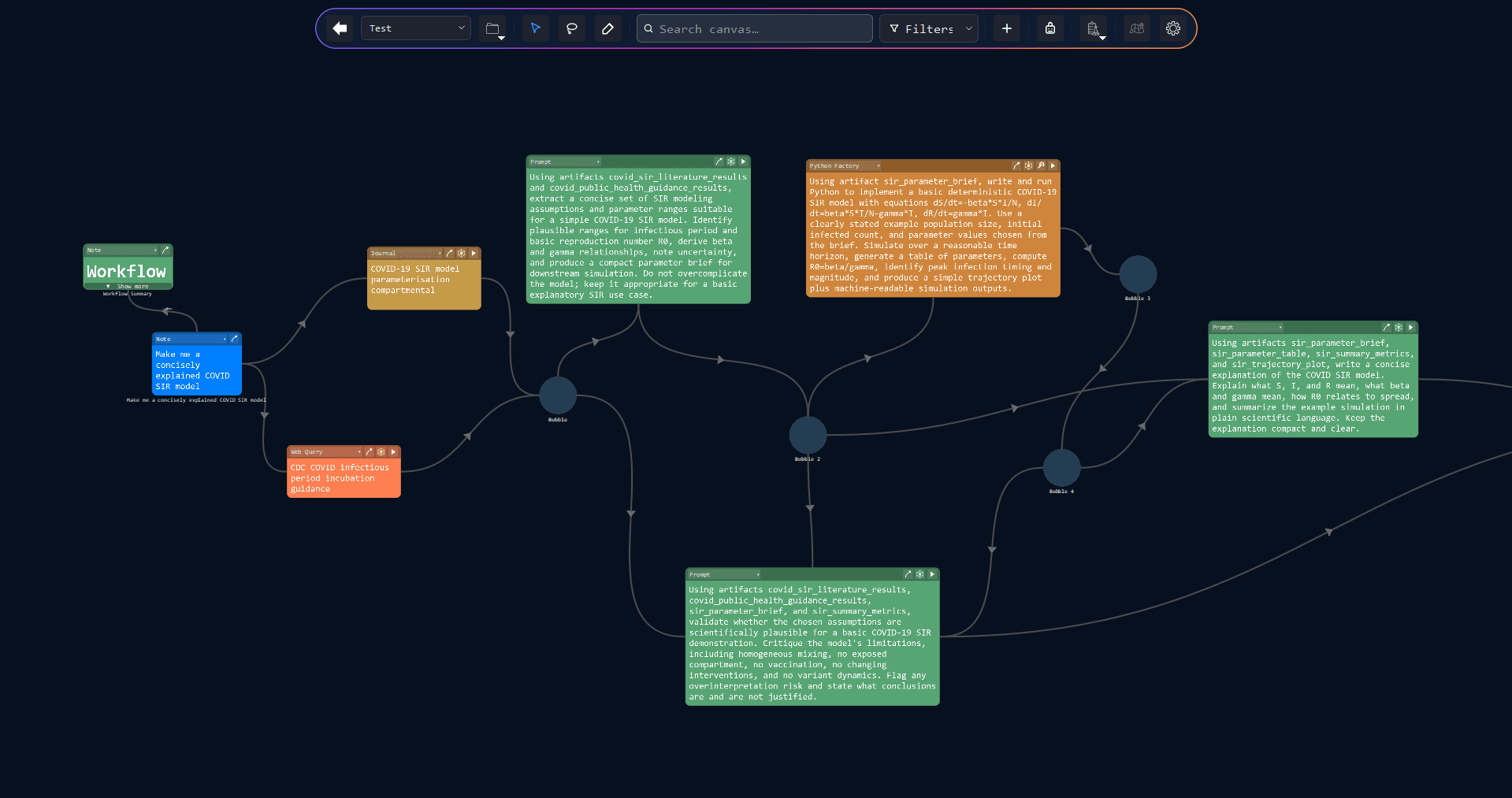
Amytis is evolving into an intuitive, visual AI workflow platform for life scientists.
Instead of treating AI as a separate chatbot, we make AI prompts, inputs and outputs part of the scientific workflow.
Researchers can decide:
What context and data an AI model receives
Which model is used for each task
How different steps connect
Which parameters and prompts are applied
How a workflow can be edited, reused and shared
This means a researcher could use a general-purpose model for one task and a specialist biological model for another.
We call this approach a universal harness: rather than locking researchers into one AI model, Amytis is designed to give them access to a broad range of models and the ability to route each task to the most appropriate one.
AI is already beginning to enable capabilities that would have sounded like science fiction a few years ago: from screening enormous compound libraries to designing novel proteins and enzymes.
We want wet-lab researchers to be able to access this kind of tooling without first becoming computational experts.
AI should augment scientists, not replace them
I don't believe the future of scientific research is AI doing the thinking for us.
That's why our vision for Amytis goes beyond simply adding an ‘AI research assistant’ to an electronic lab notebook.
We're building a research workspace where scientific data, knowledge, analysis and AI can work together, while researchers retain control over the process.
If you're a researcher, PhD student, postdoc, lab lead or university team interested in exploring what that could look like, contact us to get involved.
Get started